
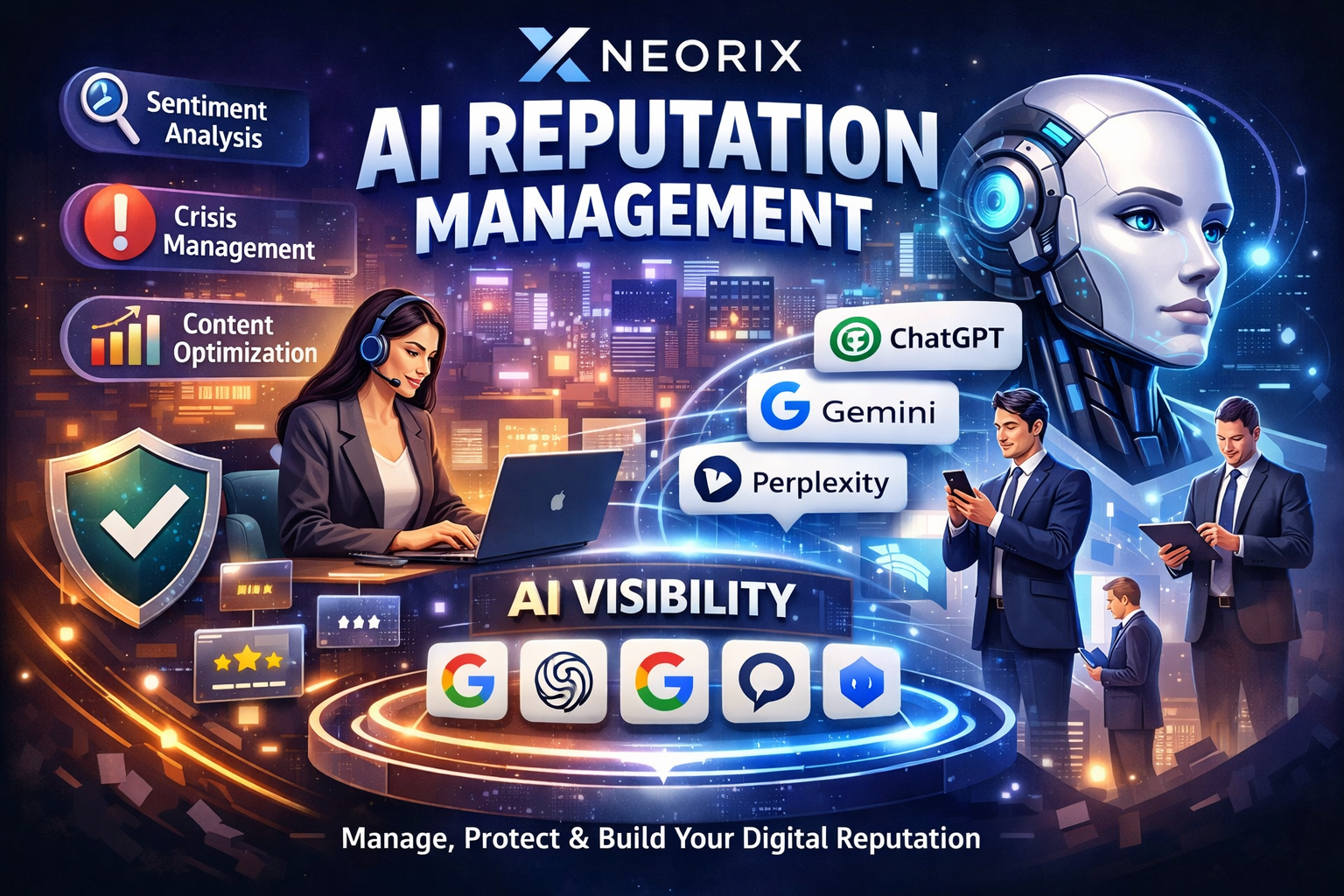
AI Reputation Management is the practice of monitoring, shaping, and protecting how your brand is perceived across AI-generated content, search engines, social media, and review platforms. With AI now responsible for 80.6% of all AI web traffic referrals in Indonesia, traditional ORM is no longer enough. NEORIX helps you ensure that when ChatGPT, Gemini, or Google AI Overviews mention your brand, the narrative is accurate, positive, and controlled.
📌 Why AI Reputation Management Matters Now
Online Reputation Management (ORM) in Indonesia has never been more complex. With 230 million internet users, 180 million active social media identities, and ChatGPT now the fourth most-visited website in the country, the platforms where your brand reputation lives have multiplied faster than most companies can track them .
The global ORM market hit USD 7.75 billion in 2026 and is projected to reach USD 22.18 billion by 2032, growing at a CAGR of 11.2%. AI adoption is the primary growth driver . In Indonesia, three factors make AI reputation management uniquely high-stakes:
1. AI Is Reshaping Reputation
When someone types your brand name into ChatGPT, Gemini, or Google AI Mode, a large language model assembles a narrative about you from thousands of sources and serves it as fact. No click required. As a Forbes Business Council article put it: “Reputation is now influenced by how AI models summarize your online presence, the sources they prioritize, and the narratives they choose to highlight” .
85% of brand mentions in AI responses come from third-party sources, not owned media . Your AI reputation depends heavily on what journalists, reviewers, and credible sources say about you, not just what you publish yourself.
2. Indonesia’s Trust Dynamic
Consumer trust in Indonesian business is extraordinarily high at 80% (Edelman Trust Barometer 2026) . However, high baseline trust means consumers feel the betrayal more sharply. Research on Indonesian insurance companies found a significant positive correlation between the Digital Reputation Index and company profits .
3. Social Media Velocity
Crises in Indonesia move at social media speed. A crisis starting as a complaint on Twitter/X can reach national news within hours. The Pertamina crisis of late 2024 saw 98% negative online sentiment (verified by Drone Emprit data), forcing mainstream media and government response through pure digital mobilization .
🛠️ What NEORIX Offers: AI Reputation Management Services
1. AI Visibility & Reputation Audit
Function: Map how your brand is currently represented across AI platforms and identify reputation risks.
What We Measure:
- AI Mention Frequency: How often your brand appears in AI responses
- AI Mention Share: Your visibility relative to competitors
- Sentiment & Context: Whether AI mentions your brand positively, neutrally, or negatively
- Citation Source Analysis: Which sources AI is using to form its opinion
- Brand Positioning: Where your brand appears in AI answers (first, second, or not mentioned)
Output: A comprehensive report with your AI Reputation Score and a strategic roadmap.
2. Brand Monitoring & Sentiment Analysis
Function: Real-time tracking of mentions, sentiment shifts, and keywords across all platforms, including AI responses .
We Monitor:
- Indonesian media (traditional and online)
- Social media platforms (Twitter/X, Instagram, TikTok, Facebook)
- Review sites (Google Maps, Tokopedia, Shopee, Gojek)
- AI-generated content (ChatGPT, Gemini, Google AI Overviews, Perplexity)
- Local forums and discussion boards
Benefit: Early warning before reputation issues escalate.
3. Search Reputation Management (SERM)
Function: Manage what appears when someone searches for your brand on Google.
What We Do:
- Suppression of negative content: Using SEO-driven strategies to reduce visibility of negative articles
- Positive asset building: Creating content that dominates key search positions
- Review management: Responding to and generating authentic reviews on Google, Tokopedia, Shopee, and Gojek
4. AI Narrative Repair & Content Correction
Function: Correct inaccuracies in how AI represents your brand.
What We Do:
- Narrative Repair: Fixing misinformation about your products, certifications, or leadership
- AI-Ready Narratives: Building accurate, easily understood narratives
- Misrepresentation Incident Response: Rapid handling when AI presents a harmful narrative
5. Crisis Management & Protection
Function: Rapid-response protocols for reputation crises .
What We Do:
- Rapid-response protocols: Pre-built frameworks for immediate action
- Stakeholder communication: Coordinated messaging
- Narrative containment: Preventing issues from escalating
- Board-level briefings: Strategic guidance for leadership
6. Crisis Response & Post-Crisis Recovery
Function: Rebuild brand trust after a reputation incident.
What We Do:
- Post-crisis reputation repair: Strategic narrative rebuilding
- Stakeholder trust restoration: Rebuilding confidence
- Long-term reputation protection: Preventing recurrence
📊 The NEORIX Approach to AI Reputation Management
Why It Matters
Research shows that studies on Indonesian insurance companies found a significant positive correlation between the Digital Reputation Index and company profits . With Edelman’s trust scores placing Indonesian business sector trust at 80%—one of the highest scores globally—reputation isn’t just a communications concern; it’s a financial performance issue .
How AI Is Changing ORM
| Traditional ORM | AI Reputation Management |
|---|---|
| Focused on Google’s first page | Extends to AI-generated content |
| Reacted to crises | Proactive monitoring and prediction |
| Manual monitoring | AI-powered real-time monitoring |
| Limited to human perception | Also considers AI interpretation |
| PR and SEO siloed | Integrated PR, SEO, content, and AI visibility |
What We Protect
- Core Brand Narrative: The fundamental story AI tells about you
- Product & Service Reputation: How AI describes what you offer
- Leadership & Founder Reputation: How executives are portrayed
- Review & Rating Integrity: Authentic and positive review profile
- Media & Public Narrative: What journalists and publications say
🔍 Real-World Examples: The Cost of Reputation Damage
Case Study: Indonesian Brand Reputation in the AI Era
A Forbes article from January 2026 notes that AI systems may already present “a condensed overview of your identity, your professional activities, and your trustworthiness” before any direct human interaction occurs . For Indonesian brands, that’s not a future risk—it’s a daily operating reality.
The Blibli AI Brand Protection Initiative
Blibli, a leading Indonesian e-commerce platform, has launched an AI-driven brand protection system to combat counterfeit products that damage seller and platform reputation . Using AI for:
- Protected brand detection: Preventing unauthorized sellers from listing protected brands
- Counterfeit identification: AI-powered detection through image recognition, product names, and descriptions
- Catalog guardrails: Ensuring product classification accuracy
🔥 Why Choose NEORIX?
| Advantage | Explanation |
|---|---|
| AI-First Approach | We understand how AI models work and how to influence them |
| Integrated Capabilities | We combine PR, SEO, content, and AI visibility expertise |
| Proven Methodology | We use documented processes, not ad-hoc responses |
| Local Understanding | We understand Indonesian platforms, media, and cultural context |
| Crisis-Tested | Our team has handled high-profile reputation crises |
📞 Contact NEORIX
📍 Office: Boyolali, Central Java, Indonesia
📱 WhatsApp: 0822-2595-0367
📧 Email: info@neorix.id
🌐 Website: www.neorix.id
🎁 Special Offer:
- Free AI Reputation Audit — Get a comprehensive audit of your brand’s reputation on ChatGPT, Gemini, and Perplexity
- 30-Minute Consultation — Discuss your AI reputation strategy with our experts
Mention the code “REPUTATION AI” when you contact us.
This page is published by the NEORIX Team as a guide for businesses seeking to protect their reputation in the AI era.
FAQ: AI Reputation Management
This page contains 33 frequently asked questions about NEORIX’s AI Reputation Management service. From basic concepts (“What is Reputation Management?”) to AI-specific concerns (“How do I fix misinformation in ChatGPT?”), these FAQs cover everything you need to know about protecting and building your brand’s reputation in the AI era.
📋 TABLE OF CONTENTS
- BASICS OF REPUTATION MANAGEMENT (Q1-Q8)
- AI & REPUTATION (Q9-Q15)
- STRATEGIES & SOLUTIONS (Q16-Q22)
- CRISIS MANAGEMENT (Q23-Q27)
- NEORIX’S APPROACH (Q28-Q33)
📌 BASICS OF REPUTATION MANAGEMENT
Q1: What is Online Reputation Management (ORM)?
Answer: Online Reputation Management (ORM) is the practice of monitoring, shaping, and protecting how your brand, products, or leadership are perceived online. It involves managing search results, social media sentiment, reviews, and media coverage to ensure the public narrative about your brand is accurate and positive.
Q2: What is AI Reputation Management?
Answer: AI Reputation Management is the extension of ORM to the AI ecosystem. It focuses on how your brand is represented in AI-generated content (ChatGPT, Gemini, Perplexity, Google AI Overviews), the sources AI uses to form opinions about you, and the narratives AI chooses to highlight . It requires proactive management of both owned and third-party content that AI models rely on.
Q3: Why is Reputation Management important for businesses?
Answer: Reputation impacts trust, which directly affects revenue. Studies on Indonesian insurance companies found a significant positive correlation between Digital Reputation Index scores and company profits . In Indonesia, where business trust is extraordinarily high at 80% (Edelman Trust Barometer 2026), reputation damage is felt particularly acutely.
Q4: What are the key components of a reputation management strategy?
Answer: A comprehensive reputation management strategy includes:
- Monitoring — real-time tracking of brand mentions and sentiment
- Proactive content creation — building positive narratives
- Search reputation management (SERM) — managing what appears in search results
- Review management — encouraging and responding to reviews
- Crisis management — rapid response protocols
- AI reputation management — managing how AI represents your brand
Q5: What is Search Reputation Management (SERM)?
Answer: SERM focuses specifically on managing what appears when someone searches for your brand on Google. This includes suppressing negative content through SEO strategies, building positive assets to dominate key search positions, and managing reviews across platforms like Google Maps, Tokopedia, Shopee, and Gojek.
Q6: What is the difference between PR and Reputation Management?
Answer: PR focuses on proactive communications and media relations to build a positive image. Reputation Management includes PR but also covers reactive crisis response, monitoring and managing online discussions, review management, and search result optimization. Reputation management is broader and operates continuously, not just during campaigns.
Q7: Who needs Reputation Management?
Answer: Any organization that cares about how it’s perceived by customers, investors, partners, or the public needs reputation management. It’s particularly critical for:
- Brands with high online visibility
- Companies in competitive industries
- Regulated industries (finance, healthcare)
- Organizations prone to public scrutiny
- Businesses with significant online sales
- Startups and growth-stage companies
Q8: What are the biggest threats to a brand’s reputation?
Answer: Common threats include:
- Negative reviews — especially those left unanswered
- Viral complaints — social media posts that gain rapid traction
- Misinformation — false information about your brand
- Data breaches — security incidents that erode trust
- Poor customer service — publicly visible service failures
- Leadership scandals — issues with executives
- AI misrepresentation — inaccurate AI-generated narratives
📌 AI & REPUTATION
Q9: How does AI affect brand reputation?
Answer: AI models like ChatGPT, Gemini, and Google AI Overviews now synthesize information from thousands of sources to form narratives about your brand . These models often present these narratives as facts without requiring users to click through to your website. 85% of brand mentions in AI responses come from third-party sources, meaning your reputation is significantly shaped by what journalists, reviewers, and others say about you, not just what you publish.
Q10: How do I know what AI says about my brand?
Answer: You can conduct an AI Reputation Audit by:
- Opening ChatGPT, Gemini, Perplexity, and Google AI Overviews
- Asking 5-10 questions about your brand, products, and leadership
- Noting whether your brand appears, in what context, and with what sentiment
For a comprehensive audit, NEORIX provides professional assessments with detailed reports and AI Reputation Scores.
Q11: What sources does AI use to form opinions about brands?
Answer: AI models pull from a wide range of sources, including:
- Your official website and owned content
- News articles and press releases
- Review platforms (Google Maps, Tokopedia, Shopee)
- Social media (Twitter/X, Instagram, TikTok)
- Forums and discussion boards (Reddit, Quora)
- Industry publications
- Competitor references
- Regulatory and legal documents
Q12: Why do AI models sometimes present inaccurate information?
Answer: AI models can present inaccurate information because they are trained on internet data that may contain errors, outdated content, or bias. They also synthesize information from multiple sources, which can sometimes lead to incorrect summarization . Additionally, if your owned content is unclear or contradictory, AI may default to third-party sources that may be inaccurate.
Q13: Can AI content be corrected?
Answer: Yes, but not by directly editing AI models. Correction requires:
- Identifying the source of the misinformation
- Updating or correcting that source
- Generating positive, authoritative content that dominates the narrative
- Using PR and SEO strategies to ensure credible sources are prioritized
This is a strategic process that takes time and consistency.
Q14: What is AI narrative repair?
Answer: AI narrative repair is the process of correcting misinformation in how AI represents your brand . This includes fixing inaccurate product descriptions, correcting misinformation about leadership, ensuring accurate certification information, and updating outdated business details. It involves a combination of content correction, PR, and SEO strategies.
Q15: How is AI reputation different from traditional reputation?
Answer: Traditional reputation is shaped by what people think about your brand. AI reputation is shaped by how AI systems summarize your online presence . While related, AI reputation is more influenced by the quality, clarity, and consistency of structured data across the web, and by mentions from authoritative third-party sources. It’s also more directly quantifiable through AI mention share metrics.
📌 STRATEGIES & SOLUTIONS
Q16: What is the first step in improving AI reputation?
Answer: The first step is an AI Reputation Audit. This maps your current reputation across AI platforms, identifies gaps, and provides a baseline AI Reputation Score . The audit reveals which sources AI prioritizes, what sentiment is associated with your brand, and where the greatest risks and opportunities lie.
Q17: What is “positive asset building”?
Answer: Positive asset building is a search reputation management strategy to create content that will dominate key search positions when someone searches for your brand or products . This typically involves creating high-quality, authoritative content that is more likely to rank than existing negative content. Positive assets can include articles, press releases, videos, social media profiles, and thought leadership pieces.
Q18: How do I manage negative reviews?
Answer: Effective review management involves:
- Respond promptly to both positive and negative reviews
- Thank reviewers for positive feedback
- Address concerns professionally in negative reviews
- Offer solutions to problems raised
- Encourage satisfied customers to leave reviews
- Use reviews as feedback to improve products or services
In Indonesia, this is particularly important across Google Maps, Tokopedia, Shopee, and Gojek.
Q19: What is sentiment analysis?
Answer: Sentiment analysis is the practice of using AI to analyze text (reviews, social media posts, articles) to determine whether the sentiment expressed is positive, neutral, or negative . NEORIX uses sentiment analysis to monitor how your brand is being perceived across media, social platforms, and AI responses, enabling early detection of emerging reputation issues.
Q20: How does SEO help reputation management?
Answer: SEO helps reputation management by ensuring that positive, owned content ranks higher than negative or competitor content when someone searches for your brand . This is called search reputation management (SERM) . By creating and optimizing positive content, you can push negative content down in search results, reducing its visibility.
Q21: How do I handle misinformation on third-party sites?
Answer: Handling misinformation requires a multi-step approach:
- Verify the misinformation exists and is inaccurate
- Contact the platform to request correction (if possible)
- Create accurate content to provide a counter-narrative
- Publish corrections through owned channels (website, social media)
- Use PR to get accurate information published on authoritative sites
- Monitor to ensure corrections are being picked up
In some cases, legal action may be warranted.
Q22: What are “guardrails” in AI reputation?
Answer: Guardrails are the rules and controls you put in place to prevent AI from misrepresenting your brand . This includes ensuring your website has clear, consistent data (structured data), accurate and up-to-date content, and sufficient authoritative backlinks. It also includes proactive content creation to ensure AI has positive narratives to draw from.
📌 CRISIS MANAGEMENT
Q23: What is reputation crisis management?
Answer: Reputation crisis management is the process of responding to a significant negative event that threatens your brand’s reputation . This can include public backlash, product issues, security breaches, misinformation campaigns, or viral negative content. It requires rapid response, clear communication, and strategic narrative management to minimize damage and rebuild trust.
Q24: What is the first step in crisis response?
Answer: The first step is immediate containment:
- Acknowledge the situation — Don’t ignore it
- Gather facts — Understand what happened
- Assess the scale — Determine how widespread the issue is
- Activate the crisis team — Assemble key stakeholders
- Prepare initial statements — Accurate, transparent, and empathetic
- Monitor — Track how the situation evolves
Q25: How do I rebuild trust after a crisis?
Answer: Rebuilding trust requires sustained, consistent effort:
- Fully resolve the issue — Address the root cause
- Communicate transparently — Share what happened and what’s being done
- Demonstrate change — Show you’ve made improvements
- Re-engage stakeholders — Reach out to affected parties
- Rebuild reputation — Use PR, content, and SEO to restore positive perception
- Prevent recurrence — Implement measures to avoid future issues
Q26: How does AI change crisis management?
Answer: AI changes crisis management by:
- Accelerating response requirements — Crises spread faster through AI-powered social algorithms
- Creating new reputation vectors — AI-generated responses can spread misinformation
- Shifting monitoring — You must now monitor AI platforms alongside traditional media
- Increasing visibility — AI summaries can amplify reputation issues
- Requiring AI-specific responses — You may need to address inaccurate AI-generated narratives
Q27: How do I prevent reputation crises?
Answer: Prevention is always better than cure:
- Proactive monitoring — Catch issues before they escalate
- Clear communication protocols — Ensure consistent, accurate messaging
- Strong customer service — Resolve complaints before they become public
- Regular reputation audits — Identify risks before they materialize
- Employee training — Ensure staff understand brand expectations
- Ethical business practices — Operate with transparency and integrity
📌 NEORIX’S APPROACH
Q28: What makes NEORIX’s Reputation Management approach different?
Answer: NEORIX’s approach is different because:
- We take an AI-first approach — understanding how AI models work and how to influence them
- We offer integrated capabilities — combining PR, SEO, content, and AI visibility expertise
- We use proven methodologies — documented processes, not ad-hoc responses
- We have local understanding — familiarity with Indonesian platforms, media, and cultural context
- We are crisis-tested — our team has handled high-profile reputation crises
Q29: How does NEORIX measure AI reputation?
Answer: We measure AI reputation through a combination of:
- AI Mention Frequency: How often your brand appears in AI responses
- AI Mention Share: Your visibility relative to competitors
- Sentiment & Context: Whether AI mentions your brand positively, neutrally, or negatively
- Citation Source Analysis: Which sources AI is using to form its opinion
- Brand Positioning: Where your brand appears in AI answers (first, second, or not mentioned)
Q30: What is the first step with NEORIX?
Answer: The first step is a free AI Reputation Audit — we’ll assess how your brand appears on ChatGPT, Gemini, Perplexity, and Google AI Overviews, providing you with a baseline AI Reputation Score and identifying key opportunities for improvement.
Q31: How long does reputation improvement take?
Answer: The timeline varies based on the issue:
- Quick wins (review responses, social media engagement): 1-4 weeks
- Content strategy impact (blog posts, articles): 2-3 months
- Search reputation improvement (SERM): 3-6 months
- AI narrative repair: 4-8 weeks to see changes, as AI models need time to incorporate updated sources
- Full reputation transformation: 6-12 months of sustained effort
Q32: What industries does NEORIX serve?
Answer: We serve a wide range of industries, including:
- E-commerce and Retail
- Hospitality and Tourism
- Finance and Banking
- Healthcare
- Manufacturing
- Real Estate and Property
- Education
- Technology
- Food and Beverage
- Professional Services
Q33: How do I get started?
Answer: Contact us via WhatsApp at 0822-2595-0367 or email info@neorix.id. We’ll schedule a free 30-minute consultation to discuss your reputation concerns and needs. From there, we’ll conduct a comprehensive AI Reputation Audit and provide a customized proposal with a clear roadmap and timeline.
Services: AI Visibility Optimization, Business Intelligence, AI Agent Development, AI Knowledge Management, AI Reputation Management, AI Transformation Consulting
- Resources: Blog, Case Studies, Free AI Visibility Audit
- Company: About Us, Our Service, Contact
- Legal: Privacy Policy, Terms of Service, Refund Policy