
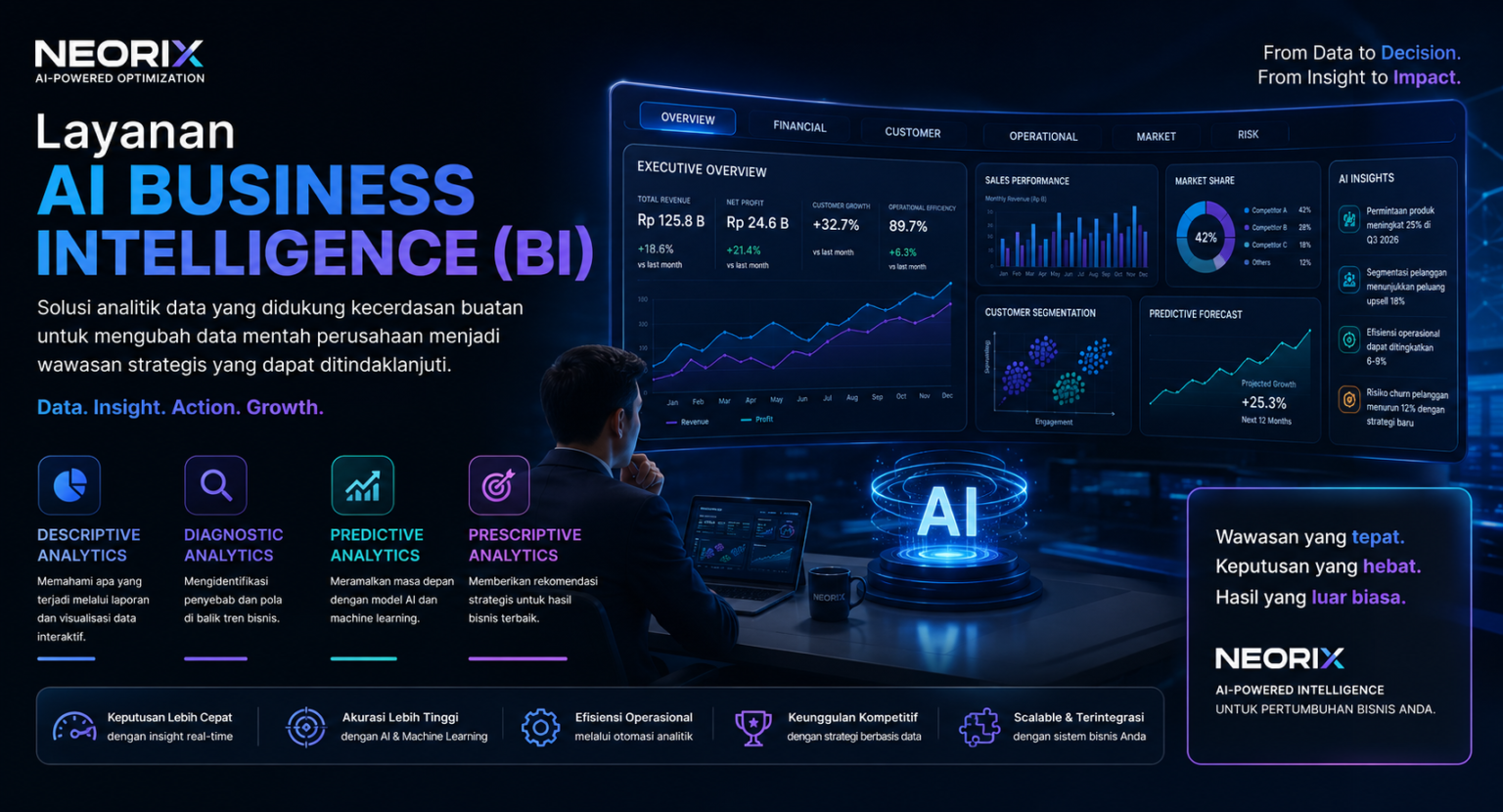
Business Intelligence (BI) is the process of transforming raw business data into actionable insights through data integration, analytics, and visualization. NEORIX’s BI service empowers decision-makers with real-time dashboards, predictive analytics, and a unified view of operations, enabling faster, data-driven decisions that boost efficiency and uncover growth opportunities .
📌 What Is Business Intelligence?
Business Intelligence (BI) is a technology-driven process that turns raw data into meaningful and actionable insights for strategic business decisions . It enables companies to collect, store, analyze, and present data from internal systems (CRM, ERP, financials) and external sources (market data, competitor intelligence) .
The core goal of BI: To help businesses move from “gut-feeling” decisions to data-driven strategies.
🛠️ Our Business Intelligence Services
NEORIX provides a comprehensive suite of BI services tailored to your business needs, ensuring your data becomes a strategic asset, not just a storage liability.
1. Data Analytics & Consulting
We perform in-depth analysis of your business data and provide strategic consulting to support accurate, data-based decision-making .
- What we do: Identify key trends, patterns, and business insights from your data .
- Output: Actionable recommendations and a clear data strategy.
2. Data Integration & Big Data Analytics
We help you unify data from disparate sources (ERP, CRM, spreadsheets, social media) into a single, governed data layer .
- What we do: Eliminate data silos and prepare complex, large-scale data for analysis .
- Benefit: Faster, more reliable access to a holistic view of your business.
3. Interactive Data Visualization & Dashboards
We present your data in clear, visually engaging formats, making complex information easy to understand and share .
- What we do: Build interactive dashboards (using tools like Power BI, Tableau, and Looker Studio) that display real-time KPIs and performance metrics .
- Benefit: Democratize data across your organization, enabling self-service analytics for non-technical users.
4. Predictive Analytics & Machine Learning
We use advanced algorithms to predict future trends and customer behavior .
- What we do: Develop forecasting models for sales, demand, and churn prediction .
- Benefit: Enable proactive, strategic planning with high accuracy.
5. Custom Analytics Application Development
We build custom applications tailored to your unique business analysis needs .
- What we do: Create bespoke solutions for specialized analytical requirements, from supply chain optimization to customer lifecycle analysis.
- Benefit: Get a solution designed specifically for your business challenges.
🔥 Benefits of NEORIX Business Intelligence
| Benefit | Description |
|---|---|
| Faster Decision-Making | Access to real-time insights and self-service analytics reduces report generation from days to hours . |
| Improved Operational Efficiency | Identify bottlenecks, optimize workflows, and reduce costs. One client achieved a 95% reduction in data-preparation effort . |
| Enhanced Customer Insights | Understand customer behavior, preferences, and churn risk to improve retention and personalize offerings. |
| Competitive Advantage | Leverage market intelligence and competitor analysis to stay ahead of the curve . |
| Data-Driven Culture | Empower all teams with governed, self-service access to trusted data, fostering a culture of data-driven decision-making . |
📊 Why Partner with NEORIX?
| Advantage | Explanation |
|---|---|
| Strategic Partner, Not a Vendor | We act as your strategic guide, providing expertise in BI architecture, data governance, and solution development. |
| Proven Methodology | We follow an end-to-end approach: from data discovery and preparation to model planning and development to ensure the prototype meets your actual needs . |
| Expertise in AI & Advanced Analytics | Our team has deep experience integrating BI with predictive analytics and machine learning to deliver forward-looking insights . |
| Focus on the Indonesian Market | We understand the local business landscape and the specific data challenges faced by Indonesian companies, from MSMEs to large enterprises . |
📞 Get Started with NEORIX BI
Ready to turn your data into a competitive weapon? Let’s talk.
📍 Office: Boyolali, Central Java, Indonesia
📱 WhatsApp: 0822-2595-0367
📧 Email: info@neorix.id
🌐 Website: www.neorix.id
🎁 Special Offer:
- Free Data Readiness Assessment: We’ll evaluate your current data infrastructure and identify quick-win opportunities for BI implementation.
- 30-Minute Strategy Consultation: Discuss your specific business needs and how BI can drive your growth.
Mention the code “BI NEORIX” when you contact us.
FAQ: Business Intelligence Service
This page contains frequently asked questions about NEORIX’s Business Intelligence (BI) service. From basic concepts (“What is Business Intelligence?”) to technical details (“What is predictive analytics?”), these FAQs cover everything you need to know about transforming your data into actionable insights, improving decision-making, and driving business growth.
📋 TABLE OF CONTENTS
- BASICS OF BUSINESS INTELLIGENCE (Q1-Q7)
- SERVICES & SOLUTIONS (Q8-Q13)
- TECHNICAL & IMPLEMENTATION (Q14-Q20)
- BENEFITS & ROI (Q21-Q26)
- NEORIX’S BI APPROACH (Q27-Q33)
📌 BASICS OF BUSINESS INTELLIGENCE
Q1: What is Business Intelligence (BI)?
Answer: Business Intelligence (BI) is a technology-driven process that transforms raw data into meaningful and actionable insights for strategic business decisions. It involves collecting, storing, analyzing, and presenting data from various sources (CRM, ERP, financials, market data) to help organizations make faster, more accurate decisions .
Q2: Why is Business Intelligence important for my business?
Answer: BI is crucial because it enables data-driven decision-making, replacing guesswork with evidence. Companies using BI can identify trends, optimize operations, improve customer experiences, and gain a competitive advantage. Data-driven organizations are 2-3 times more likely to outperform their competitors .
Q3: What’s the difference between BI and data analytics?
Answer: BI focuses on what happened and what is happening (descriptive and diagnostic analytics) through dashboards and reports. Data analytics (specifically predictive and prescriptive analytics) focuses on what will happen and what should be done. BI provides the historical and current context; advanced analytics provides the foresight. Both are complementary .
Q4: Who needs Business Intelligence?
Answer: Any organization—from MSMEs to large enterprises—that wants to make informed decisions, improve efficiency, and stay competitive. Specific beneficiaries include:
- Executives needing a high-level performance overview
- Operational managers tracking KPIs
- Marketing teams analyzing campaign effectiveness
- Finance teams managing budgets and forecasts
- Sales teams identifying growth opportunities
Q5: Can small businesses benefit from BI?
Answer: Absolutely. Small and medium businesses can benefit significantly from BI by:
- Understanding customer behavior patterns
- Identifying best-selling products/services
- Optimizing inventory and cash flow
- Tracking marketing ROI
- Competing more effectively with larger businesses
Many BI solutions today are affordable and designed for smaller businesses, including free tools like Looker Studio and Google Sheets.
Q6: What’s the difference between BI and Big Data?
Answer: BI focuses on analyzing structured data to support business decisions. Big Data refers to extremely large datasets (volume, velocity, variety) that traditional tools can’t handle. BI can be applied to big data, but it requires specialized tools (like data warehouses and advanced analytics platforms) to process and analyze that scale of information.
Q7: What are the key components of a BI system?
Answer: A modern BI system typically includes:
- Data sources (internal and external)
- Data integration/ETL (Extract, Transform, Load)
- Data storage (data warehouse, data lake)
- Data modeling (star schemas, cubes)
- Analytics engine (query, OLAP, data mining)
- Visualization & reporting (dashboards, charts)
- User access (web, mobile, embedded)
📌 SERVICES & SOLUTIONS
Q8: What services does NEORIX offer under Business Intelligence?
Answer: NEORIX provides a comprehensive BI suite, including:
- Data Analytics & Consulting: In-depth analysis and strategic guidance
- Data Integration & Big Data Analytics: Unifying disparate data sources
- Interactive Data Visualization & Dashboards: Custom dashboards in Power BI, Tableau, or Looker Studio
- Predictive Analytics & Machine Learning: Forecasting models for sales, demand, and churn
- Custom Analytics Application Development: Bespoke solutions for unique needs
Q9: What is data integration and why is it important?
Answer: Data integration is the process of combining data from different sources (ERP, CRM, spreadsheets, social media) into a single, unified view . It’s important because data silos prevent a holistic understanding of your business. Integration provides a single source of truth, eliminates manual data consolidation, and enables accurate, comprehensive analysis .
Q10: What is a data dashboard?
Answer: A data dashboard is a visual display of key performance indicators (KPIs) and metrics, presented in a single, easy-to-understand screen. It provides a real-time or near-real-time snapshot of business performance, allowing users to monitor progress, identify issues, and make decisions quickly. NEORIX builds custom dashboards in tools like Looker Studio, Power BI, and Tableau.
Q11: What is predictive analytics?
Answer: Predictive analytics uses statistical algorithms and machine learning techniques to identify the likelihood of future outcomes based on historical data . It answers questions like: “Which customers are at risk of leaving?” or “What will demand be next quarter?” It transforms BI from a rear-view mirror into a forward-looking compass.
Q12: What is data visualization?
Answer: Data visualization is the graphical representation of data using visual elements like charts, graphs, and maps . It makes complex data more accessible, understandable, and usable. Effective visualization helps users quickly grasp patterns, trends, and outliers, enabling faster and more intuitive decision-making .
Q13: What is a data warehouse?
Answer: A data warehouse is a centralized repository that stores integrated data from multiple sources. It’s optimized for reporting and analysis, not for day-to-day transactions . Data warehouses provide the clean, structured, and historical data foundation required for effective BI and analytics.
📌 TECHNICAL & IMPLEMENTATION
Q14: How is data cleaned and prepared for analysis?
Answer: Data cleaning and preparation involve several steps to ensure data quality:
- Removing duplicates: Identifying and deleting duplicate records
- Standardizing formats: Ensuring consistency (e.g., date formats, currency)
- Handling missing values: Filling or removing incomplete data
- Correcting errors: Fixing typos and inaccuracies
- Validating data: Checking for consistency and logic
This is often the most time-consuming part of a BI project but is critical for reliable insights.
Q15: What is ETL (Extract, Transform, Load)?
Answer: ETL is a data integration process that:
- Extracts data from various source systems
- Transforms it (cleansing, validation, joining, aggregation)
- Loads it into a target system like a data warehouse
ETL is the backbone of any BI implementation, ensuring data is properly prepared for analysis.
Q16: What are KPIs in BI?
Answer: KPIs (Key Performance Indicators) are measurable values that demonstrate how effectively a company is achieving key business objectives . Good KPIs are:
- Specific and measurable
- Aligned with business goals
- Actionable (you can influence them)
- Timely (you can track them regularly)
Examples: Monthly Revenue Growth, Customer Retention Rate, Average Order Value.
Q17: How long does a typical BI implementation take?
Answer: The timeline varies based on scope and complexity:
- Small project (basic dashboard): 2-4 weeks
- Medium project (integrated data warehouse + dashboards): 2-4 months
- Large enterprise project: 4-12 months
NEORIX follows an agile approach, delivering value in phases and iterating based on feedback.
Q18: What tools does NEORIX use for BI?
Answer: NEORIX is vendor-agnostic and selects the best tool for your needs. Commonly used tools include:
- Visualization: Looker Studio, Power BI, Tableau, Google Sheets
- Data Integration: Apache Airflow, Talend, custom scripts
- Data Warehousing: BigQuery, Snowflake, PostgreSQL
- Advanced Analytics: Python, R, BigQuery ML
Q19: What is a data mart?
Answer: A data mart is a subset of a data warehouse focused on a specific business department or function, like sales, marketing, or finance . It’s designed to meet the specific needs of a particular user group, making it faster and easier to access relevant data.
Q20: What is real-time BI?
Answer: Real-time BI provides up-to-the-minute data and insights, enabling immediate action. This is achieved through technologies like streaming data, in-memory analytics, and continuous data refresh . It’s critical for operations like fraud detection, dynamic pricing, and supply chain monitoring.
📌 BENEFITS & ROI
Q21: What is the ROI of Business Intelligence?
Answer: The ROI of BI can be substantial. Benefits include:
- Cost savings: Through operational efficiency and reduced manual reporting
- Revenue growth: By identifying sales opportunities and improving customer retention
- Risk reduction: Through better forecasting and proactive problem-solving
- Faster decision-making: Reducing time-to-insight from days to minutes
Most organizations see a positive ROI within 6-12 months of a well-executed BI implementation.
Q22: How does BI improve decision-making?
Answer: BI improves decision-making by providing:
- Data-driven evidence: Replacing gut feeling with facts
- Timely information: Access to real-time or near-real-time data
- Holistic view: Integrating data from all parts of the business
- Predictive insights: Foreseeing trends and potential issues
- Interactive exploration: Enabling users to drill down and ask “what if” questions
Q23: How does BI help with competitive advantage?
Answer: BI provides competitive advantage by:
- Identifying market trends before competitors
- Understanding customer needs and behaviors deeply
- Optimizing pricing and product strategies
- Improving operational efficiency to deliver better value
- Enabling faster and more agile responses to market changes
Q24: How does BI help with customer experience?
Answer: BI enhances customer experience by:
- Understanding customer preferences and buying patterns
- Personalizing marketing messages and recommendations
- Predicting customer churn and taking proactive measures
- Identifying pain points in the customer journey
- Segmenting customers for more targeted service
Q25: How does BI support cost reduction?
Answer: BI supports cost reduction by:
- Identifying inefficiencies in operations
- Optimizing inventory levels (reducing carrying costs)
- Pinpointing high-cost areas and waste
- Improving resource allocation
- Reducing manual reporting efforts
Q26: Can BI help with risk management?
Answer: Yes. BI supports risk management by:
- Providing early warning signals for potential issues
- Analyzing historical patterns to identify risks
- Enabling scenario planning and forecasting
- Monitoring compliance metrics
- Detecting anomalies and fraud patterns
📌 NEORIX’S BI APPROACH
Q27: What makes NEORIX’s BI approach different?
Answer: NEORIX’s BI approach is different because:
- We act as a strategic partner, not just a vendor
- We start with business questions, not just data
- We provide end-to-end support from data strategy to visualization
- We focus on practical, actionable insights that drive real business value
- We combine BI with advanced analytics and AI capabilities
- We understand the Indonesian business landscape and its unique challenges
Q28: What is the first step in working with NEORIX on BI?
Answer: The first step is a free consultation to understand your business goals, pain points, and current data environment. We then conduct a data readiness assessment to evaluate your data infrastructure and identify quick-win opportunities. From there, we develop a customized roadmap and proposal.
Q29: Do I need to have all my data in one place before starting?
Answer: No. We can help you integrate your data from various sources (including spreadsheets, POS systems, CRMs, and social media) as part of the implementation. We’ll build the data pipeline and integration required to unify your data for analysis.
Q30: What if my team doesn’t have technical data skills?
Answer: That’s perfectly fine. We build solutions that are intuitive and user-friendly, requiring minimal technical expertise. We can also provide training for your team to enable self-service analytics and build a data-driven culture within your organization.
Q31: How do you ensure data security and privacy?
Answer: Data security is a top priority. We follow best practices including:
- Data encryption in transit and at rest
- Access controls (role-based permissions)
- Compliance with data privacy regulations (GDPR, PDP)
- Secure data integration using industry-standard methods
- Regular security assessments for our own systems
Q32: What industries do you serve?
Answer: NEORIX serves a wide range of industries, including:
- E-commerce & Retail
- Manufacturing
- Finance & Banking
- Healthcare
- Hospitality
- Property & Real Estate
- Education
- Logistics
We tailor our BI approach to the specific challenges and opportunities of each industry.
Q33: How do I get started with NEORIX’s BI service?
Answer: Contact us via WhatsApp at 0822-2595-0367 or email info@neorix.id. We’ll schedule a free 30-minute consultation to discuss your business needs. From there, we’ll conduct a data readiness assessment and provide a customized proposal with a clear roadmap and timeline.
Services: AI Visibility Optimization, Business Intelligence, AI Agent Development, AI Knowledge Management, AI Reputation Management, AI Transformation Consulting
Legal: Privacy Policy, Terms of Service, Refund Policy
Resources: Blog, Case Studies, Free AI Visibility Audit
Company: About Us, Our Service, Contact